For a Grandparent
Chinese characters for the elder who has shaped a generation.
Recommended characters
孝 (Xiào) — Filial Piety
For the grandparent who has been the object of the practice long enough to know whether it has been given. 孝 names the reciprocal of their own care — the recognition that the relationship is foundational, and that the recognition is owed explicitly. Unlike 德 (which names their character) or 长寿 (which wishes them more years), 孝 names the direction: this is given to them, from a generation they have shaped.
仁 (Rén) — Benevolence
For the grandparent whose way of treating the people around them has been the consistent example — not advice given or roles performed, but the ongoing orientation toward family that a long life makes legible. 仁 is specific to this: not long life itself (that is 长寿), not health (that is 康宁), but the quality of attention and care that has made their presence worth observing. A recognition, not a wish.
德 (Dé) — Virtue
For the grandparent who has accumulated the kind of moral character that a long life, lived consistently, produces. 德 is the recognition that their way of being has been the example — not advice given but conduct maintained over decades, absorbed by grandchildren in ways that only become clear later.
长寿 (Cháng Shòu) — Longevity
For the grandparent at a milestone birthday. 长寿 is the plainest of the longevity wishes — more years, unqualified — and the one Chinese families inscribe on birthday plaques and longevity peaches for elders celebrating a 60th, 70th, or 80th. Unlike 安康 (which wishes for health within those years) or 康宁 (which wishes for ease), 长寿 names only the foundational thing: continued presence.
康宁 (Kāng Níng) — Health and Ease
For the grandparent at a milestone birthday. 康宁 — the third of the Five Blessings (五福) in the Book of Documents — names both the physical and interior condition of a life lived well: health in body (康) and settled calm in mind (宁). A more specific choice than 安康, which wishes for safety; 康宁 wishes for the quality of wellbeing that a healthy, undisturbed mind produces.
平安喜乐 (Píng Ān Xǐ Lè) — Peace · Safety · Joy · Gladness
For the grandparent at a milestone birthday or New Year. 平安喜乐 names the two conditions that make additional years genuinely valuable: that body and daily life remain undisturbed (平安), and that the family’s gathering produces real gladness rather than mere obligation (喜乐). A more personal choice than 福寿安康, which offers a formal catalogue of blessings — 平安喜乐 names the felt quality of the years themselves.
贤 (Xián) — Worthy Character
For the grandparent whose decades of choices you are now old enough to recognize for what they were. 贤 names demonstrated worth — the combination of practical competence and moral consistency that a long life makes visible. Unlike 德 (which names accumulated virtue broadly) or 仁 (which names orientation toward others), 贤 specifically recognizes the capacity to meet what was required, and the record of having done so.
伟 (Wěi) — Greatness
For the grandparent whose long life has been genuinely formative — not just present but consequential in the shape of what the family has become. 伟 names the stature visible from outside: not the virtues (that is 德) or the long life itself (that is 长寿), but the accumulated consequence of a life that organized what surrounded it. At a milestone birthday, it names what generations of relationship have made legible.
铭 (Míng) — Inscription
For the grandparent whose teaching has become permanently part of the family’s way of living. 铭 names what a grandparent leaves that is distinct from the long life itself (长寿) or the demonstrated virtue (德): the specific lessons and examples that have been pressed into grandchildren as durable as bronze inscriptions — still present, still available, not requiring retrieval. The gift that names the inscription rather than the inscriber.
祥和 (Xiáng Hé) — Auspiciousness and Harmony
For the grandparent at a milestone birthday when the occasion calls for the fullest seasonal blessing. 祥和 names both what a long life receives from the world (the favorable signs that accumulate over decades of right conduct) and what the elder has given back to the household (the sustained accord that makes those signs worth having). Unlike 长寿 (which names more years) or 德 (which names accumulated character), 祥和 names the total condition: a life in which the world has been well-disposed and the family has met it with genuine warmth.
安泰 (Ān Tài) — Peace and Cosmic Right-Order
For the grandparent at a milestone birthday when the gift should name a life that has held at both scales — the personal and the cosmic. 安泰 names the complete double condition: the world in its right order (泰) and the person genuinely settled within it (安). Unlike 祥和 (which names the auspicious omen paired with household accord), 安泰 names the wider cosmic peace and the interior peace together — what a long life earns when both the self and the world have, across the full arc, been in their right relation. Most apt for the grandparent whose milestone is the occasion to name something larger than health or character alone.
仁爱 (Rén Ài) — Benevolent Love
For the grandparent whose long life has made the compound’s argument legible. 仁爱 describes the love whose direction — not just the feeling — has been sustained across generations: the benevolent orientation toward grandchildren and the wider family that 仁 names as a principle and 爱 names as the act. More specific than 长寿 (which names the years) or 德 (which names accumulated virtue broadly), 仁爱 names the particular quality of care that has been the grandparent’s way of being present — undemonstrative, outward-facing, structural.
忠孝 (Zhōng Xiào) — Loyalty and Filial Piety
For the grandparent at a milestone birthday when the gift should name both the faithfulness demonstrated across a lifetime (忠 — the centered-heart orientation toward family and commitment, sustained through all the years those qualities were being observed) and the recognition that the occasion makes explicit (孝 — the filial acknowledgment that runs across generations, from those who were shaped toward those who did the shaping). Where 德 names accumulated virtue broadly and 长寿 names the years themselves, 忠孝 names the relational substance of those years: the wholehearted faithfulness and the acknowledgment it has earned.
五福临门 (Wǔ Fú Lín Mén) — The Five Blessings Arrive at the Threshold
For the grandparent at Chinese New Year — the occasion on which the complete inventory of a good life is most appropriately named. 五福临门 names what a long life has required all along: longevity (寿), sufficiency (富), health and inner peace (康宁), a genuine disposition toward virtue (攸好德), and a peaceful natural end (考终命). Where 长寿 names only the years and 安泰 names the cosmic scale, 五福临门 names all five together — the complete endowment, arriving at the elder’s threshold for the new year.
父爱如山 (Fù Ài Rú Shān) — A Father’s Love Is Like a Mountain
For the grandfather whose long life has made the phrase undeniable — whose love across the generations was registered as a fixed point the family oriented by rather than as anything he ever said. Where 长寿 wishes more years and 伟 names his stature, 父爱如山 names the love itself in the one image Chinese culture reserves for the steadfast and the weight-bearing: the high ground a child looks up to and the mass that does not move. The gift for the grandfather whose presence has been the household’s mountain.
厚德载物 (Hòu Dé Zài Wù) — Deep Virtue Carries All Things
For the elder whose long life is itself the proof of what the phrase means — the grandparent who carried a family through decades and whose composure under weight you understood only once you had weight of your own. Where 长寿 wishes more years and 德 names the character accumulated across them, 厚德载物 names what that character was for: the bearing. The line from the 坤 hexagram of the Book of Changes compares deep virtue to the earth, which holds everything placed on it without buckling. The milestone-birthday gift for the grandparent who was the ground the whole family stood on.
温 (Wēn) — Warmth
For the grandparent people are simply glad to sit beside — whose defining quality, across all the years, has been a warmth of manner rather than any single virtue. 温 is more specific than 仁 (which names their orientation toward others) and more felt than 德 (which names accumulated character): it names the temperature of their presence, the thing that made the house easy to come back to. For the elder whose warmth, more than their advice or their stature, is what every grandchild carries forward.
慈 (Cí) — Tender Love for the Young
For the grandparent whose kindness has always pointed downward — toward children, then grandchildren, then whoever in the family was smallest. 慈 names exactly that direction: the protective, indulgent love an elder gives the young, the quality a Chinese speaker hears in 慈祥, the word reserved for a kind elder’s face. Where 仁 names their orientation toward all people and 温 names the warmth of their presence, 慈 names the particular softness grandparents are allowed — the tenderness that shelters and asks nothing back.
泰 (Tài) — Grand, Settled Peace
For the grandparent whose long life has arrived somewhere steady — who no longer reaches for anything, because everything important is already in place. 泰 names that condition: not merely safe (安) but settled at scale, flourishing and unforced, the grand calm of a life running well. Where 长寿 wishes more years and 厚德载物 names the weight they carried, 泰 names where the carrying finally let them rest — the composure of 泰然, at ease with nothing left to prove. The gift for the elder who has become the family’s steady center.
宽 (Kuān) — Magnanimity
For the grandparent whose long life has produced the breadth a long life is supposed to: the magnanimity of someone who has seen enough to forgive much and feels no need to be small about anything. 宽 names that interior room — the latitude to let a grandchild’s mistakes pass, to hold people unlike them without needing them to change. Where 慈 names the tenderness aimed downward at the young and 温 names the warmth of their presence, 宽 names the generosity of spirit extended in every direction. The recognition of the elder who has made room for everyone, and the quiet strength it took to keep that room open.
盛 (Shèng) — Flourishing
For the grandparent whose line has multiplied and prospered — the elder at whose New Year table the family gathers full and thriving, three generations in one room. 盛 names that flourishing: not the years themselves (长寿) or the settled calm they have arrived at (泰), but the vigorous, growing life of the household they rooted. A recognition as much as a wish — the family is 兴盛, and they are the source it grew from.
太平 (Tài Píng) — Great Peace
For the grandparent who measures a good life not by what they gained but by the years that passed without disaster reaching the family’s door. An elder who has lived through hard times knows what 太平 is worth — peace at the scale of a whole age, 天下太平, the rare stretch in which ordinary life simply goes on. Where 泰 names the settled calm they have personally arrived at and 盛 names the thriving line they rooted, 太平 names what they most want for the years that remain and for the generations after them: peaceful times, the inheritance an elder hopes to pass down more than any other.
富足 (Fù Zú) — Abundance · Well-Provided
For the grandparent whose household has come to rest in plenty — provided for after a lifetime of work, wanting for nothing in the years that remain. Where 盛 names the thriving line they rooted and 康宁 names health and settled ease, 富足 names the material sufficiency specifically: the well-stocked home an elder has earned, the striving finally over, enough at last. The 足 in the pair matters most for an elder — it names the moment the chasing can stop, when what the household has is plainly enough. The milestone gift for the grandparent whose long labor has built a home that now simply provides.
慈祥 (Cí Xiáng) — Kindly and Gentle
For the grandparent you would recognize from across a room — by the soft eyes and unhurried smile before they even speak. Where 慈 names the tender love an elder points downward at the young, 慈祥 names that love grown visible, settled into a face over decades; you would never call a young parent 慈祥, only the old. More about demeanor than 温 (the warmth of their presence) and gentler than 宽 (the room they make for everyone), it names the benign, welcoming calm a grandchild grows up inside and never once has to brace against.
金玉满堂 (Jīn Yù Mǎn Táng) — Gold and Jade Fill the Hall
For the grandparent at whose New Year table the family gathers full — the elder for whom 满堂 carries its second meaning, the hall filled not only with gold and jade but with 儿孙满堂, children and grandchildren in one room. Where 富足 names the material sufficiency a long labor has earned and 盛 names the thriving line they rooted, 金玉满堂 names both at once: the household abundant and the hall crowded with descendants. The Spring Festival gift for the grandparent whose home you hope stays full in every sense — provided for, and surrounded.
笑口常开 (Xiào Kǒu Cháng Kāi) — May the Laughing Mouth Stay Open
For the grandparent whose laugh you want to keep hearing for many more birthdays. The phrase leans on the folk line 笑一笑,十年少 — one laugh, ten years younger — which makes a glad face a kind of medicine, so the wish for an open mouth becomes a wish for a long and well-kept life. Where 长寿 wishes the years themselves and 康宁 wishes health and settled ease within them, 笑口常开 wishes the cheer that folk wisdom says keeps an elder young — years still glad enough to laugh through.
年年有余 (Nián Nián Yǒu Yú) — A Surplus Year After Year
For the grandparent whose long labor built a household that now simply provides — the elder at whose New Year’s Eve table the whole fish is served and left unfinished so the year carries something over. Where 富足 names the material sufficiency a lifetime of work has earned and 长寿 wishes the years themselves, 年年有余 wishes the security that renews with each of them: a home that ends every year a little ahead of the line, never running short in the years that remain. The Spring Festival gift for the elder you want to picture provided for not once but reliably — a reserve that comes back, season after season.
容 (Róng) — Capacity and Composure
For the grandparent whose long life has turned into pure room — the elder who takes the whole family in, three generations at one table, and is unsettled by none of it. 容 names two things a long life is supposed to leave and rarely does: 包容, the capacity to hold everyone without needing them to be different, and 从容, the unhurried composure that capacity settles into on a face. Where 宽 names the breadth measured as latitude and 慈 names the tenderness aimed down at the young, 容 names the act of containing itself — and the grace it wears outwardly. The recognition for the elder nothing small can crowd, whose calm the whole family has learned to steady itself by.
团圆 (Tuán Yuán) — The Family Gathered Whole
For the grandparent at the head of the reunion table — the elder around whom three generations gather, whose long life is counted in the faces that come home each New Year. Where 长寿 wishes the elder more years and 容 names the room they keep for everyone at once, 团圆 names the occasion both are for: the whole line assembled in one place, the family made briefly whole with its oldest member at the center. The gift for the grandparent whose dearest measure of a year is the reunion — who wants the seats filled more than anything that could sit on a shelf.
兴旺 (Xīng Wàng) — A Line Still Thriving
For the grandparent whose life’s work is legible in a headcount. 人丁兴旺 — the household thriving in people — is the wish spoken over elders at the New Year, and it is a plainer sentence than it sounds: 丁 is a word off the imperial tax registers, so the phrase says something close to “the roll is longer than it was.” 香火兴旺 says it from the altar instead — the incense still being lit, which means only that someone is still there to light it. Where 团圆 wishes the family gathered for a night, 兴旺 names what they are counting when they gather. Closest to 盛, and worth the distinction: 盛 is the grand register, said of eras and of lives at their height; 兴旺 is the ordinary one, said of households — and here it is the line, not the elder, still climbing. The gift for the grandparent whose truest measure of a good life is how many people it produced.
博爱 (Bó Ài) — Universal Love
For the grandparent whose kindness was never rationed to their own blood — the elder who fed the neighbor’s children alongside their grandchildren, who was 阿姨 or 爷爷 to half the lane, whose door and table were open to whoever needed them. Where 仁爱 names the sustained, inward-facing love an elder pours into the family and 慈 names the tenderness aimed down at the young, 博爱 names the width of the heart: love that crossed the household gate long ago and kept reaching. The recognition for the grandparent whose long life is remembered by more people than share their name.
端庄 (Duān Zhuāng) — Dignified Grace
For the grandparent whose bearing has only grown more dignified with the years — the composed, upright presence that can quiet a room without a word. 端庄 is not the warmth of 温 or the kindliness of 慈祥; it names the poise a long life settles into, the self-possessed gravity that draws respect on its own and never has to ask for it. A recognition of the dignity an elder has earned and grown into.
感恩 (Gǎn Ēn) — Gratitude
For the grandparent who raised you, or filled the years your parents could not — the elder to whom the debt of care runs deepest and is least often spoken. 感恩 names that gratitude: the felt weight of a life made possible by someone else’s care. It was a grandmother, after all, whom Li Mi refused an emperor to nurse, calling his wish 乌鸟私情 — the private feeling of the crow that feeds its aged parents. Where 慈祥 names the kindliness they showed and 长寿 wishes them more years, 感恩 says the thing they rarely hear: that what they gave is seen, and held with thanks.
紫气东来 (Zǐ Qì Dōng Lái) — Purple Vapor Comes from the East
For the grandparent at whose courtyard gate the family gathers each New Year — the elder whose door the inscription belongs above. 紫气东来 is the four-character scroll across a lintel, declaring auspicious fortune drawing toward this threshold from the east; hung over an elder’s gate at Spring Festival, it wishes the household ahead of it a year with good already on the road to its door. Where 五福临门 names the complete inventory of blessings arriving and 金玉满堂 pictures the hall crowded and full, 紫气东来 names the approach itself — the sign read over the gate, not the fortune yet inside. It is the more lettered of the door blessings, the one with Laozi and his green ox behind it, and so it suits the grandparent whose gate you want to say something with a mind in it. The Spring Festival gift for the elder at the head of a household you want to picture with fortune already drawing near.
出入平安 (Chū Rù Píng Ān) — Safe Passage Coming and Going
For the grandparent at whose door the family gathers each New Year — and whose own comings and goings, to the market and the clinic and back, the family has quietly begun to watch. 出入平安 is the horizontal banner (横批) hung over an elder’s gate at Spring Festival, wishing the household ahead of it the plainest thing: that everyone who passes through, the elder most of all, goes out and returns unharmed. Where 岁岁平安 wishes the same peaceful year repeating and 康宁 wishes health and settled ease, 出入平安 wishes safe passage across space — every trip out the door and safely back.
身体健康 (Shēn Tǐ Jiàn Kāng) — May Your Body Be Well
For the grandparent you now ask about before anything else — whose stairs have gotten slower, whose appointments the family has quietly started tracking. 身体健康 is the wish that usually comes first in a New Year greeting to an elder, spoken before anyone mentions luck or money, because the order of that list is a judgment about what the rest depends on. Where 健康长寿 belongs to the banner behind a milestone birthday table and 康宁 comes out of the Five Blessings, 身体健康 carries no literary claim at all — which is the source of its weight, since a wish with no register cannot be mistaken for a performance. The gift for the grandparent whose health you think about far more often than you say.
宏 (Hóng) — Grand Scale · Vast Vision
For the grandparent who was planning for people who did not exist yet. 宏 is the character for scope — the household, the line, the decades someone was plainly working on long before anyone now at the table arrived — and among elder gifts it is unusual for pointing forward rather than back. Where 德 names the character they built and 长寿 asks for more of their years, 宏 names the horizon they chose: a life sized past its own span.
旺 (Wàng) — The Household Loud
Almost everything on this page is addressed to the elder: 长寿 asks for more of their years, 身体健康 for their body, 德 and 仁 credit what they built. 旺 is addressed past them, to the house. It is a word about heat and rate — 火旺, a hearth going hard; 人气旺, a room with enough people in it to feel warm — and it forecasts nothing, which is unusual among elder gifts and, for some grandparents, a relief. 团圆 asks that everyone come back for the one night. 兴旺 wishes the line upward over decades. 旺 asks only for the ordinary state of a full house, this winter and again next winter. The gift for the grandparent whose measure of a good year has always been how many people came and how late they stayed.
禄 (Lù) — One Post, Four Decades
This is the one character on the page that describes an arrangement the recipient actually lived inside. Nobody has drawn 禄 for a century — wages are 工资 and have been for generations — but the person who took one posting at twenty-two and retired out of it at sixty worked under the assumptions the older word carried: that a job was a place in a structure, that the pay came with the place, and that both had to be deserved in order to be kept. 禄 names that arrangement. 富足 on this page describes what the household ended up with; 德 and 贤 credit the character that got it there. 禄 names the mechanism in between — the post held, the wage drawn on it, the family built on the wage. It is the least sentimental thing that can be said to an elder, and for a great many of them the most accurate.
昌盛 (Chāng Shèng) — The Line, Not the Room
家族昌盛 is what gets said at a table with three or four generations sitting at it, and its subject is the branch rather than anyone sitting there. That puts it next to 兴旺 higher up the page, and the two are worth separating carefully, because they are counting different things. 兴旺 counts the present: 人丁兴旺, the roll longer than it was, the room fuller this year than last. 昌盛 counts the span, and asks that the line go on doing well over a stretch nobody at the table will live to see the end of. It is also the more formal of the two by a wide margin — the register of the plaque and the toast rather than of the New Year greeting — and for the grandparent whose real subject in conversation is the grandchildren rather than themselves, that formality lands as accuracy. Where 长寿 asks for more of their own years, this one says the thing they have actually been keeping score of is going to be fine.
欢聚一堂 (Huān Jù Yī Táng) — That People Still Come
团圆 higher up this page is the family circle closed, and it counts — it is always aware of which chair is empty. This phrase counts nothing, and for an elder that turns out to be the kinder of the two. It says only that people came and were glad to be there, which leaves room for the grandchild who could not get the flight and for the guests who are not kin at all: the neighbors, the old colleagues from the work unit, the classmates who still book a lunch every spring. Most of this page is addressed to the grandparent’s body or to their line — 身体健康 to the one, 昌盛 to the other. This one is addressed to their calendar. It says the house is still the place everyone comes to, and that the coming is not duty.
喜气洋洋 (Xǐ Qì Yáng Yáng) — The Gate That Gets the Paper
Two 横批 on this page go above the same lintel and do opposite jobs. 紫气东来 reads the horizon and says something good is drawing toward the gate. 喜气洋洋 turns around and says what is behind it: lanterns up, the kitchen started before light, the first callers due mid-morning. For an elder the difference matters, because their household is usually where the New Year actually happens — the gate everyone drives to, the courtyard the red paper actually gets pasted on. 昌盛 higher up this page is addressed to the line and 身体健康 to the body; this one is addressed to the house, on the one week of the year it is full. It says only that the place was glad and showed it, and that somebody thought that worth writing down.
长乐未央 (Cháng Lè Wèi Yāng) — The Sentence Nobody Adjusts Downward
Most of what is given to an elder asks for more of something — 身体健康 for the body, 昌盛 for the line, the whole 寿 vocabulary for years. 长乐未央 asks for nothing to be added. Han usage reads 未央 as 未尽, not used up, so the claim concerns a supply rather than an extension of it: the good years are not spent. That distinction lands harder at eighty than at thirty, because wishes offered to the old are so often quietly scaled down before they are spoken — fewer years hoped for, the hope trimmed to stay plausible. This phrase is said the same way to anyone, and was said that way for two thousand years off the eaves of buildings that had no idea who was standing underneath. 欢聚一堂 higher up this page is addressed to their calendar and 身体健康 to their body. This one is addressed to the run they are still in.
春 (Chūn) — Counted in Seasons
Chinese counts a life in seasons rather than in numbers: 春秋, spring-and-autumn, is the everyday way to speak of how much of it someone has done. By that reckoning a grandparent has seen 立春 land on frozen ground more times than anybody else at the table, and has been right about it every time — the date runs ahead of any evidence for it, and the evidence has always come. That is a specific thing to say to an elder, and a different one from the rest of this page. 身体健康 is addressed to the body and 长乐未央 to the run they are still in. 春 is addressed to their judgment: the one person present who never needed to see a year start before believing it would.
祥 (Xiáng) — No Occasion Required
长寿 counts the years, 康宁 addresses the body, 感恩 answers something they did for you. 祥 counts nothing and answers nothing. It reports that conditions around a person are well-disposed — a finding rather than a wish — which makes it the thing on this page you can give in a year with no milestone in it and no particular reason. 祥和 higher up makes two claims at once, that the season was favorable and that the household was in accord; 祥 makes only the first, and asks the family to vouch for nothing. For the grandparent you want to say something to in an ordinary year.
吉 (Jí) — The Side of Life That Is Not a Funeral
Chinese ritual sorts occasions into two classes and names one of them with this character. 《周礼》 puts 吉礼 at the head of the five kinds of state ceremony and 凶礼 immediately after; 吉服 is simply what a person wears once they are out of mourning; 吉事 is the standing term for everything on the celebratory side of that line. This is what 吉 carries that the softer characters on this page do not. 长寿 counts years and 康宁 addresses the body — both of which get harder to say lightly as someone ages. 吉 counts nothing and diagnoses nothing. It names the ordinary, non-mourning body of life and wishes an elder more of it, which is a plainer thing to say at an age when most people around them have started speaking carefully.
廉 (Lián) — The Inheritance That Is Not Money
《后汉书》 records that when friends pressed 杨震 to buy land so his sons would have something behind them, he refused, and said what he intended to leave instead: 使后世称为清白吏子孙 — let later generations call them the children of a clean official. His descendants took him seriously enough that 四知堂 — the hall-name commemorating the night he sent a visitor’s gold back — has been carried by the family ever since, and is still painted over doorways today. That is the register this character occupies for an elder. It is not a wish for the years ahead, which the rest of this page covers well — 泰, 康宁, 身体健康, 长寿. It is a finding about the years behind, and specifically about a kind of decision that leaves no paperwork, since nothing was taken and nothing was owed. For the grandparent whose grandchildren inherited a name that has never had to be explained.
宽厚 (Kuān Hòu) — The Verdict That Comes From Below
忠厚长者 is a thing said about an elder and never by one, and it points at the peculiarity of this word: its evidence is collected entirely from underneath. Grandchildren, daughters-in-law, tenants, apprentices, the people who could not have objected if the answer had gone the other way — they are the only witnesses 宽厚 accepts, which is why it cannot be claimed and takes decades to accumulate. 宽 higher up this page is half of it, the room an elder leaves for other people’s mistakes. 容 is the composure that holds when the news is bad. 宽厚 adds the outbound half that neither covers: the money, patience and standing handed to people with no claim on any of it, in amounts nobody wrote down. For the grandparent whose reputation in the family was settled long ago by people much younger than they were.
一元复始 (Yī Yuán Fù Shǐ) — The Count They Have Kept Longest
Under 虚岁, the reckoning most elders were raised on, nobody aged on their birthday: a baby was one year old at birth and everyone in the country gained a year together on the morning of 初一. Age was a position in the public calendar rather than a private anniversary, which is why this phrase belongs to the New Year and to a birthday equally — the two were, for most of the people on this page, one occasion. What it says on either is narrow and does not flatter. 长寿 and 身体健康 elsewhere on this page ask for more of something; 泰 and 康宁 describe a condition they are in. This asks for nothing and describes nothing. It observes that the marker has returned to the head of the count — not to zero, with everything behind it still standing — and for someone who has watched that happen eighty times, the fact that the head is the same place every time is the part worth putting on a wall.
安心 (Ān Xīn) — 老者安之
When Confucius’s students asked what he himself wanted, the answer ran to nine characters and the first three were 老者安之 — give the old their ease. Not longer life for them, not honor: 安 used as a verb, with an elderly person in the object slot on the standard reading, and somebody else doing the settling. That grammar is the whole of this word, and it is why it sits differently from the rest of this page. 长寿 and 身体健康 ask the world for more of something on their behalf; 泰 and 康宁 describe the condition they are already in. 安心 describes nothing about them. A grandparent’s attention typically runs two generations down and reports to nobody, and this is the gift addressed to that — not to how they are, but to what they may stop checking.
吉星高照 (Jí Xīng Gāo Zhào) — The Year the Calendar Singles Out
Sixty is a 本命年, and so is eighty-four — every twelfth birthday returns a person to the animal they were born under. Sixty returns them to the start of the whole sexagenary round as well, which is why it has a name of its own, 花甲. Eighty-four is doubly marked, because folk reckoning pairs it with seventy-three — the ages Confucius and Mencius are each said to have reached — as thresholds a family makes a point of seeing someone past. These are the birthdays that actually get marked, and they are marked in the older way: something red, handed over rather than bought. This phrase belongs to that occasion specifically rather than to birthdays in general. It comes from the almanac, the book of 宜 and 忌 that an elder is far more likely than their grandchildren to have consulted in earnest, and it lifts one heading out of it — 吉星, the rank the good ones are sorted under — and puts it overhead with nothing else attached. 感恩 further up this page is addressed to what they have given and 身体健康 to how they are keeping. This one is addressed to the year they are walking into, on the birthday the calendar itself picks out.
母慈子孝 (Mǔ Cí Zǐ Xiào) — Visible in Three Generations at Once
孝 higher up this page is what one person owes another. This phrase is what a grandmother can watch happening in a room she is sitting in — her own child now doing the first clause for somebody small, and still doing the second one for her. That doubling is the reason it lands differently here than it does on a mother’s page: a grandparent is the only person in the family who occupies both halves at the same time, and the only one who has had long enough to find out whether the first clause held. It is a report rather than a wish, and the years that make it true are hers.
睿 (Ruì) — 老人家很睿智
长寿 counts the years and 容 names the manner. 睿 is a claim about neither. It is the character inside 老人家很睿智, the thing a family says about an elder whose account of something turned out to have more floors under it than anybody else’s — the position that made no sense to the room until it did. 深明 is what the 说文 puts against it: not clarity on its own, but clarity with a depth attached. Everything the character carries above the eye is about digging rather than about light, and the word ends up measuring how far down somebody got rather than how fast. 柳宗元 used it in 810 for the student who sat through a whole day of teaching without one objection and looked, to everyone watching, as though nothing had landed; it took 孔子 until afterwards to establish otherwise, by watching what the student did. That is the argument for giving it to a grandparent rather than to anyone younger. This is a quality nobody can assess on the day, and an elder is the person a family has watched for long enough to be sure of it.
俭 (Jiǎn) — 勤俭持家
For the elder whose house ran on a hand nobody in it could see at the time. The compound is 勤俭持家 — keeping a house on hard work and restraint together — and Chinese says it with respect, not with pity: it credits skill, not shortage. The nearest thing to a rule is a line from 朱柏庐’s seventeenth-century household text, still copied onto schoolroom walls: 一粥一饭,当思来处不易. Rice on a table arrived by somebody’s labour, and the restraint is owed to the labour rather than to the price. Grandparents rarely deliver that as an instruction. It comes across in how a kitchen was run and in what a family was allowed to throw away, which is why the character usually gets recognised a generation late — at the point where you are the one deciding what goes in the bin.
承 (Chéng) — Two Generations Further Back
A grandparent is usually the furthest-back person in a family still available to be told that something got through. That is what this character does and all it does. The oldest forms of 承 draw two hands coming up from below a kneeling body, and the word has meant taking the weight ever since. 孝 at the top of this page names what is owed upward, and 铭 credits the sentences of theirs that stuck. This one reports an outcome instead, and the outcome is often odd in exactly the way real inheritance is odd — what came through skipped the middle generation, or nearly did, and the grandchild is the one who turned out to be doing it. The dumpling method, the refusal to waste anything, the trade nobody else in the family wanted. 杜甫 put the family version of it in five characters while writing to his son about a craft his own grandfather had started: 诗是吾家事. For the grandparent whose line reached somebody, with the evidence now standing in front of them.
弘 (Hóng) — The Character a Grandfather Chose
康熙 settled on this character for a whole generation of his grandsons, which is how the future 乾隆 came to be 弘历 — a grandfather picking the word for widening and hanging it on children who had not yet done anything. Handed the other way, from a family to its elder, it stops being a hope and becomes an account. 宏 higher up this page names the horizon they were working toward. 弘 names what became of the things they were handed on the way there: the trade, the recipe, the standard for what this family does not do. Across sixty or seventy years they are the only person left who saw both ends of those, and the widening happened in increments too small to register from inside the house. 承 elsewhere on this page tells them something got through to a later generation. This tells them it got through larger than it arrived.
祥云 (Xiáng Yún) — They Will Know It by Sight
An elder has been looking at this pattern their whole life, usually without anyone naming it: the cloud scroll is what runs across a court robe, around the border of a New Year print, through the 云板 pierced into the 华表 columns at 天安门, and along the collar of a bride’s 云肩. It is recognized before it is read. That makes it an unusual thing to hand to someone who has been receiving characters for eighty years: the recipient has the reference already. What the paper adds is the name for it — and a name is what lets a pattern somebody has looked past their whole life get looked at directly for once.
善缘 (Shàn Yuán) — The Advice, Handed Back
广结善缘 is advice an older person gives a younger one, usually at the start of a first job, and usually to someone who cannot yet see the point of it. Sixty years later the person who gave it is the only one in the family standing far enough back to check the result, and the honest report is that even they cannot tell which of the ties mattered. That is not a failure of the advice; it is what the word says about itself. 承 elsewhere on this page tells them something got through to a later generation, and 弘 tells them it got through larger. Giving this one reverses the direction the sentence originally travelled: the instruction comes back up to the person who issued it, as a finding rather than a lesson.
康泰 (Kāng Tài) — The Question Asked From Far Away
Chinese letter etiquette sorts its closings by who is receiving them, and the elder row is the one that asks about the body: 敬祝康泰. That is where this word has always lived — written down, by somebody who is not in the room to see for themselves. 身体健康 elsewhere on this page is what gets said out loud at the door on New Year morning; 康泰 is the written form of the same sentence, and it narrows rather than widens. 康 is what the body still has in reserve, 泰 is whether anything is in the way of spending it. 康宁 adds a settled mind to the sound body, and 安泰 opens the same 泰 out to the scale of a world in right order. This one asks after the body and stops there — which is the only question a family two thousand miles away can actually get an answer to.
天伦之乐 (Tiān Lún Zhī Lè) — Across the Generations
长寿 asks for more years; 团圆 asks for a full table; 德 names their character. 天伦之乐 names the gladness of being kin across generations — grandparents, parents, children in one bond — without requiring every seat filled or every year counted. For the elder whose gift should say the family relation still feels like joy.
五谷丰登 (Wǔ Gǔ Fēng Dēng) — The Granary Register
长寿 asks for more years; 天伦之乐 names kinship gladness; 金玉满堂 fills the hall with treasure. 五谷丰登 keeps the older household floor: the staple grains come in full, the year readable as a harvest that landed. For the elder whose New Year or house gift should speak of provision in the granary sense — not a fish left over, not a promotion toast.
厚 (Hòu) — The Compliment Said Backwards
People do not walk up to an elder and announce that they are 厚道. They tell a third person, and they put a negative in the sentence: 他待人不薄. Stripping that negative off and handing over the bare character is about as direct as this compliment gets. 宽厚 above is assembled from witnesses who had no leverage. This character is not asking about leverage. It asks whether the quantity was ever the thin one, including toward people who did have some — a daughter-in-law, a sibling, the grandchild who cost money for twenty years. 长寿 on this page counts years. This counts the margin inside them.
恩 (Ēn) — The Bond the Favor Left
感恩 above is the grandchild’s feeling. 德 above is character, and 长寿 counts years. This character is 恩情: what an elder bestowed that is still in the younger people, including a stretch of childhood spent in their house. The word does not change between one season of care and a whole generation. 一饭之恩 is the small end of that ledger, meals that refused to stay the size of meals. For the grandparent whose gift should name what they gave.
福 (Fú) — Blessing · Good Fortune · Happiness
See 福 →寿 (Shòu) — Longevity · Long Life · Health and Vitality
See 寿 →康 (Kāng) — Health · Well-being · Wholeness
See 康 →敬 (Jìng) — Respect · Reverence · Honor
See 敬 →平安 (Píng Ān) — Peace · Safety · Well-being
See 平安 →安康 (Ān Kāng) — Peace · Health · Wholeness of Body and Mind
See 安康 →福寿 (Fú Shòu) — Blessing · Longevity · A Long and Happy Life
See 福寿 →龙 (Lóng) — Dragon · Power · Auspicious Strength
See 龙 →力 (Lì) — Strength · Force · The Power to Act
See 力 →岁岁平安 (Suì Suì Píng Ān) — Peace Year After Year
See 岁岁平安 →健康长寿 (Jiàn Kāng Cháng Shòu) — Good Health · Long Life
See 健康长寿 →龙马精神 (Lóng Mǎ Jīng Shén) — The Vigor of the Dragon and Horse · Tireless Spirit
See 龙马精神 →顺 (Shùn) — Smooth Going · Flowing Well · Without Obstruction
See 顺 →福寿康宁 (Fú Shòu Kāng Níng) — Blessing · Longevity · Health · Peace
See 福寿康宁 →福寿安康 (Fú Shòu Ān Kāng) — Blessing · Longevity · Peace · Health
See 福寿安康 →Bring a hand-brushed piece home — choose how you'd like it brushed.
-
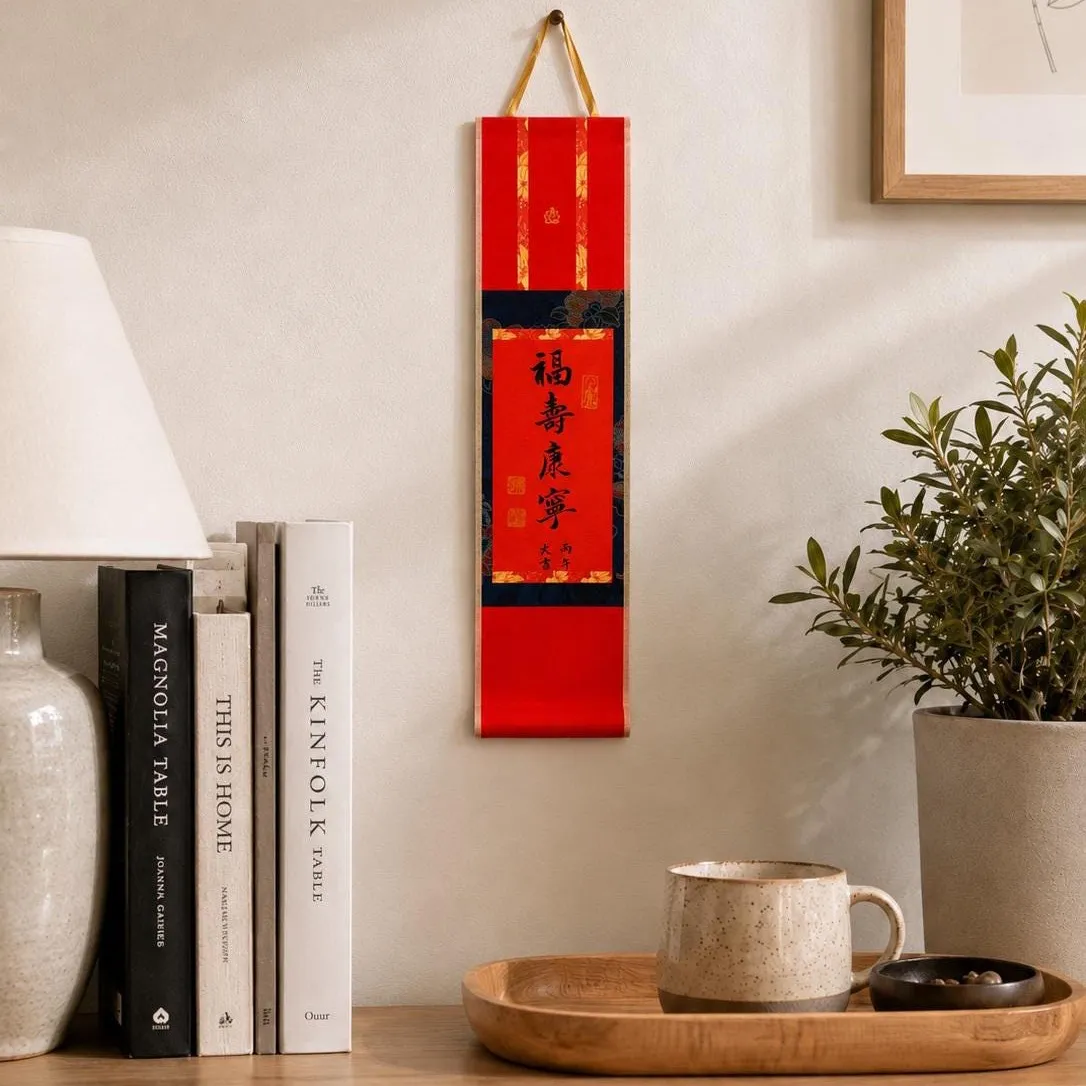
Photo shows a sample — yours will be brushed with the character you choose.
Wall Scroll — for walls & housewarmingsfrom $38→ -
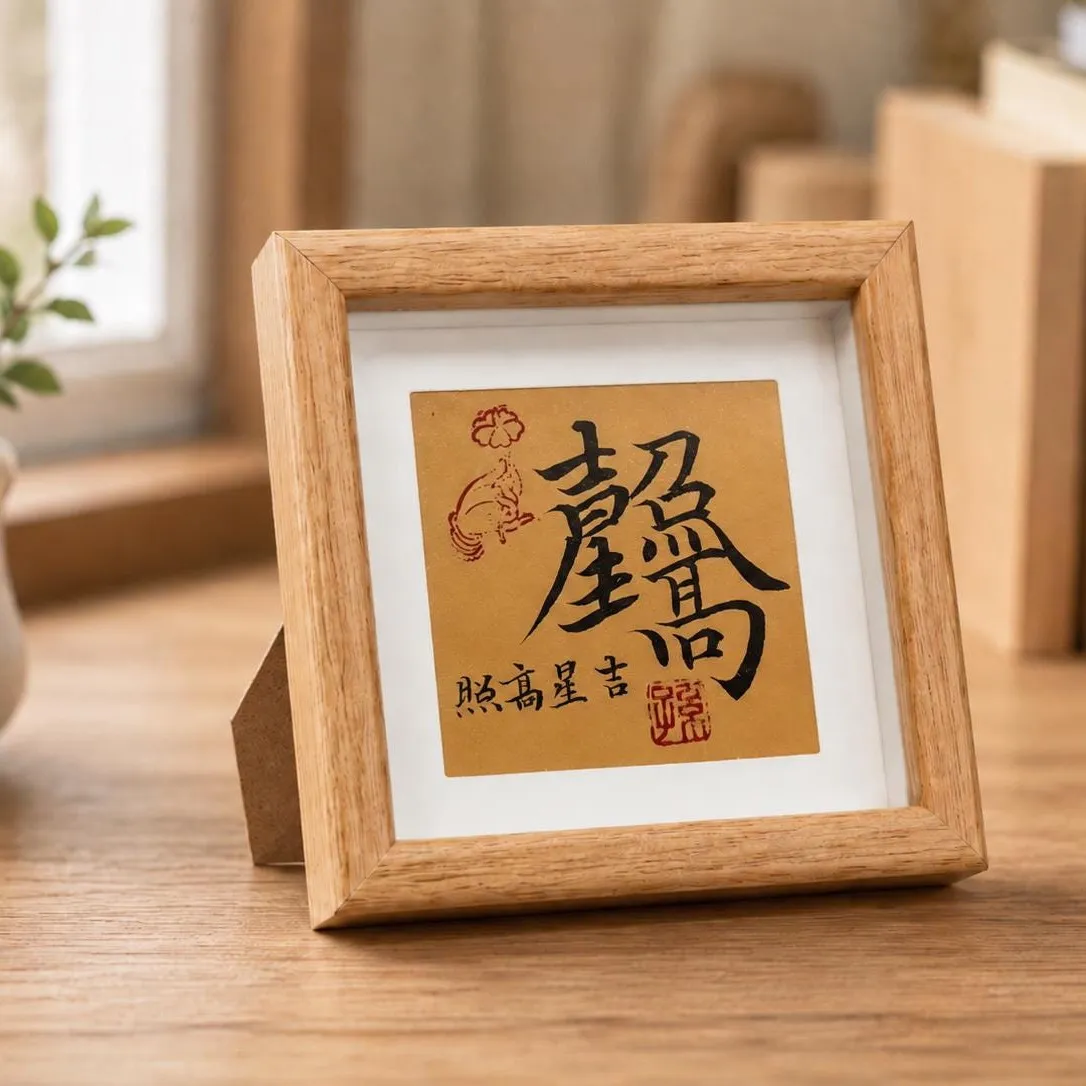
Photo shows a sample — yours will be brushed with the character you choose.
Desk Frame — for desks, studies & studiosfrom $44→