For a Boss or Mentor
Chinese characters that say thank you and I wish you well without crossing any professional lines.
Recommended characters
仁 (Rén) — Benevolence
For the boss or mentor who has exercised authority in a way that makes the people under it feel regarded rather than managed. 仁 in a professional context names specifically what 德 names more broadly: the orientation toward others that makes leadership different from administration. Where 德 covers the full arc of moral character, 仁 names the directional quality — the turn toward the team — that has made this person’s influence worth something.
德 (Dé) — Virtue
For the boss or mentor whose professional conduct has been worth studying. 德 in a workplace context names something rarer than competence: the character that makes authority trustworthy and judgment worth following when it is difficult. A gift that takes a position on the kind of professional the recipient has been.
忠 (Zhōng) — Loyalty
For the boss or mentor whose reliability has had the quality of 忠厚 — grounded, weighty, without calculation. 忠 names the character of a mentor who has given honest counsel rather than easy agreement, who told you what you needed to hear rather than what was comfortable. It recognizes the kind of professional faithfulness that is an orientation, not a career move.
明 (Míng) — Clarity
For the boss or mentor whose clear-sightedness makes them the person you can bring genuine complexity to. 明 names the quality of a leader who is not swayed by how things are presented — who distinguishes the actual state of a project from the face put on it. Confucius defined 明 in the Analects as the specific resistance to being moved by gradual rumor or sharp immediate complaint: a precision that still describes the rarest thing in organizational leadership.
毅 (Yì) — Resolve
For the boss or mentor whose resolve you have watched hold in conditions where most people would have changed course or softened their position. 毅 names the quality of a leader who distinguishes the moment that genuinely warrants revision from the moment that is simply hard — and who does not confuse the two. A gift that names the character behind the professional example.
刚 (Gāng) — Principled Firmness
For the boss or mentor whose professional position has not been moved by what made accommodation convenient — by the pressures of authority above, by the temptation of easy agreement below. 刚 names the interior firmness that makes 刚正不阿 (firm, upright, not inclining toward power) a lived fact rather than a career posture. Where 德 names the full arc of their character and 明 names their clear-sightedness, 刚 names what made both possible: the interior that did not bend.
铭 (Míng) — Inscription
For the boss or mentor whose professional guidance has been genuinely formative — whose counsel and example have become part of how you approach your work, available without prompting. 铭 names this quality specifically: not the mentor’s clear-sightedness (明) or their principled firmness (刚), but the permanence of what they left in you. The gift that names the lesson rather than the teacher, given when the lesson has lasted long enough to be recognized as lasting.
忠孝 (Zhōng Xiào) — Loyalty and Filial Piety
For the boss or mentor whose professional faithfulness has taken the form of genuine 忠 — honest counsel, steady orientation toward your actual development, commitment to the relationship that did not bend when accommodation was easier — and whose years of mentorship have created something analogous to 孝: the recognition that what they gave cannot be fully returned, and that naming it honestly is the closest approximation. The most complete of the professional recognition pairs, for the mentor whose guidance has been formative enough to warrant both halves of the classical accounting.
明德 (Míng Dé) — Manifest Virtue
For the boss or mentor whose professional conduct has been genuinely formative — not just competent or principled, but visible in its effects on the team and on what the team produces. 明德 distinguishes itself from 德 (accumulated moral character) precisely in the word 明: the virtue that has come forward into the work, made manifest in how authority is exercised and the standard maintained. Where 德 names what the mentor has accumulated over years, 明德 names what those years have brought into the room. The gift for the professional whose example has been an instruction — not absorbed without awareness, but legible.
才华 (Cái Huá) — Talent and Brilliance
For the boss or mentor whose leadership has had a quality beyond competence or principle — the particular way they approach a problem, run a conversation, or frame a situation that makes their contribution recognizable before anyone explains it. 才华 is not 德 (accumulated character) or 明 (clear-sightedness); it names the specific natural endowment that their professional style has been built on. The recognition gift for the mentor whose talent has been the thing you learned from, not just their example.
担当 (Dān Dāng) — Taking Responsibility
For the boss or mentor who has consistently been the person who stepped between the team and the difficulty — who did not wait for formal designation but read the situation and owned what needed owning. 担当 is distinct from 德 (accumulated moral character) or 忠 (sustained faithfulness): it names the pattern of initiative, the act of picking up the load before anyone assigned it. The recognition for the professional whose reliability has always had this particular quality.
栋梁 (Dòng Liáng) — Pillar of Strength
For the boss or mentor whose authority in the organization has been specifically load-bearing — not the quality of their moral character (德), the clarity of their perception (明), or the firmness of their interior (刚), but the structural fact that the organization’s coherence has depended on them being in position. 栋梁 is the most elevated professional recognition in the catalog: the claim that without this person, the structure itself — not just its performance — would be different. The right choice when professional accomplishment alone fails to name what is actually being recognized.
刚毅 (Gāng Yì) — Firm Resolve
For the boss or mentor whose professional record demonstrates both properties of intactness: the principled firmness (刚) that kept their standard consistent when factional pressure or client pressure made accommodation convenient, AND the determination (毅) that continued difficult work through adversity, demotion, or professional setback. 刚毅 is more specific than 德 (accumulated moral character) and more complete than either 刚 or 毅 alone. The recognition for the professional whose career — looked at across enough time — proves both qualities in opposite circumstances.
前程似锦 (Qián Chéng Sì Jǐn) — A Brilliant Road Ahead
For the boss or mentor at a graduation, promotion, or career threshold — when the gift should name the terrain opening before them rather than a quality the relationship has already observed. 前程似锦 is the prospective choice: where 明德 asks the professional to manifest the virtue they have accumulated and 栋梁 names the structural role they are moving toward, 前程似锦 describes the territory itself. The boss whose career is entering a new phase, told: the road ahead is as brilliant and detailed as brocade, and you have earned the right to be on it.
步步高升 (Bù Bù Gāo Shēng) — Step by Step, Rising Higher
For the boss or mentor at a promotion, a new role, or New Year — the gift that names continued upward movement rather than a quality accumulated (明德) or a structural role filled (栋梁). 步步高升 given to a superior is the New Year toast tradition: a junior raises a glass and delivers the phrase as a public acknowledgment that the senior’s trajectory is upward and the year should carry that motion forward. Less a wish than a declaration of observed direction — the most conventional of the career-blessing phrases, and the one delivered most often in the formal social grammar of the banquet.
厚德载物 (Hòu Dé Zài Wù) — Deep Virtue Carries All Things
For the leader whose real work is bearing weight — the boss who absorbs the pressure and the blame so the team keeps its footing. Where 明德 asks them to manifest accumulated virtue and 栋梁 names the structural role they fill, 厚德载物 names the capacity that role demands: to be loaded with responsibility, other people’s trust, and hard decisions, and to hold under it without dropping anyone. Half of the Tsinghua University motto, it treats the act of carrying others as the highest form of character — the tribute for the superior whose steadiness under load you only understood once you carried weight of your own.
自强不息 (Zì Qiáng Bù Xī) — Strengthen Yourself Without Rest
For the boss or mentor whose career reads, in the end, as a long refusal to coast — who kept sharpening themselves long after they had earned the right to stop. Where 厚德载物 names the weight they bear for the team and 栋梁 names the structural role they fill, 自强不息 names the personal discipline that built them: the self-strengthening that continued with no one above them requiring it. It is the active half of the Tsinghua motto, paired by design with 厚德载物 — drive yourself forward like heaven, and carry others like the earth. The gift for the leader whose example was not what they said about effort but that they never visibly relaxed it.
天道酬勤 (Tiān Dào Chóu Qín) — The Way of Heaven Rewards the Diligent
For the boss or mentor who built something the slow way and would credit the result to effort rather than genius. Where 厚德载物 names the weight they carry and 自强不息 names their refusal to coast, 天道酬勤 names the conviction their whole career argues for — that sustained, unglamorous work is what the world most dependably repays. It is a gift that returns their own lesson to them: the example they set was never that they were the cleverest in the room, but that they trusted effort to compound, and were proven right. The acknowledgment that the long game they played was the correct one.
谦 (Qiān) — Modesty
For the boss or mentor whose competence you were left to discover rather than told about — who let the work make the case and declined to make it themselves. Where 德 names the full arc of their character and 才华 names the talent their style was built on, 谦 names the restraint laid over both: the discipline of holding real ability and not advertising it. 满招损,谦受益 — fullness invites loss, modesty keeps the gains coming; the leader who kept saying “I’m still learning” is the one who kept learning, and kept the room willing to teach them. The gift for the superior whose authority never needed announcing.
宽 (Kuān) — Magnanimity
For the boss or mentor whose authority has always left people room — to be wrong, to learn slowly, to grow into the work rather than arrive finished. 宽 names the breadth that the best leadership requires and the worst lacks: the magnanimity to overlook small faults and forgive real ones without abandoning the standard. Confucius made it the first thing he looked for in anyone holding power — 居上不宽, a leader without breadth was not worth watching. Where 谦 names the competence they declined to advertise and 仁 names their orientation toward the team, 宽 names the latitude itself — paired in classical thought with 严 (rigor), not against it, because the best superiors knew exactly when to leave room and when to hold the line.
谦和 (Qiān Hé) — Modest and Amiable
For the boss or mentor whose seniority never came with distance — who stayed reachable when their position would have excused them from it. 谦和 is the verdict the dynastic histories saved for the official everyone could approach: real ability held quietly (谦) and a level ease that let juniors speak first (和). Where 谦 names the modesty they laid over their competence and 宽 names the room they left others to grow into, 谦和 names the social fact those produced — the superior you never had to brace yourself before. The recognition for the boss whose authority was easiest to learn from precisely because it was never hard to be near.
开卷有益 (Kāi Juǎn Yǒu Yì) — There Is Profit in Opening a Book
For the boss or mentor who never stopped being a student — whose office has a shelf, whose counsel came with a book recommendation, who read widely enough that their judgment always seemed to draw on more than the matter at hand. 开卷有益 is the phrase Emperor Taizong of Song used to defend reading a thousand-volume encyclopedia through, three scrolls a day: there is profit in opening any book, and it is no labor. Where 明 names the clear-sightedness you brought your hard problems to and 谦 names the modesty that kept them saying “I’m still learning,” 开卷有益 names the habit that fed both — a leader whose authority was informed rather than merely positional. The gift for the mentor who taught you, more than any single lesson, to keep reading.
端 (Duān) — Uprightness
For the boss or mentor whose authority rested on being straight — the same in every meeting, principled where bending would have been easier, correct in conduct without ever making a show of it. 端 names uprightness you can see: 品行端正, the proper bearing that made their word reliable before it was ever tested. Where 谦 names the competence they declined to advertise and 宽 names the room they left others to grow into, 端 names the line itself — the moral square-corner a team measures itself against. The gift for the superior whose integrity was never announced because it never needed to be.
慎 (Shèn) — Prudence
For the boss whose authority rested on never acting rashly — the one who weighed a decision, checked the thing you would have missed, and was as careful at the close of a project as at the kickoff. 慎 names that considered care: 谨慎, the prudence you trusted with what mattered, and 慎独, the discipline that held even when no one was watching. Where 端 names the uprightness you could see and 谦 names the competence they declined to advertise, 慎 names the judgment underneath both — the reason the hardest calls landed on their desk. The gift for the superior whose steadiness came from thinking things through, not from moving fast.
博 (Bó) — Breadth
For the manager whose range you have quietly leaned on — the one who has context on nearly everything, who can place your small problem inside the larger picture because they have read and seen widely enough to hold both at once. 博 honors that breadth of mind without crossing into flattery: it names a quality, not a favor. It says you have noticed that their judgment rests on an unusually wide foundation — the mark of someone who kept learning well past the point they had to.
鹏程万里 (Péng Chéng Wàn Lǐ) — A Flight of Ten Thousand Li
For the boss or mentor who is moving on — the departure gift from a team to the person who led it, when the send-off should honor where they are going rather than tally what they did here. 鹏程万里 carries the peng’s flight from the 庄子: ten thousand li open, the whirlwind already under the wings. Where 栋梁 names what they were to this organization and 谦和 names what they were like to work under, 鹏程万里 faces forward — the professional farewell that says the next thing deserves them, signed by the people who watched them earn it. Well suited to the group gift at a farewell dinner.
远 (Yuǎn) — Far · Long Range
For the boss or mentor whose call only made sense later. 远 is the character behind 高瞻远瞩 — to look from a height and gaze far — the standard Chinese praise for foresight, and it credits something specific: not that they were right, but that they were looking further out than the room was. Where 德 names the character that made their authority worth following and 谦和 names what they were like to work under, 远 names the thing you actually learned from them. A professional gift that takes a clear position and still stays inside the lines.
通 (Tōng) — Open · Connected
For the manager whose door was not a figure of speech. 通 names an open line, and in a working relationship the thing that closes it is usually the person above you: the decision that could not be revisited, the reasoning you were never shown. This is the boss who could be argued with on the merits and who occasionally lost, then said so in the room. Where 谦和 names how they carried themselves and 远 names how far ahead they were looking, 通 names the thing that made the job workable day to day — 通情达理, understanding of the situation and reachable by reason. A thank-you for the leader you did not have to manage upward around.
禄 (Lù) — The Provision of a Post
Almost everything else here credits a boss for a quality: 德 the character behind the authority, 栋梁 the weight they carry, 远 how far ahead they were looking. 禄 credits the office itself, and specifically what the office provides. Under the Han a governor’s rank was a quantity of grain — 二千石, two thousand piculs, used as his name — and the character kept that meaning: provision that exists because a post exists and someone holds it properly. Given to a manager, it does not wish them a raise. It says that a dozen people can plan a year because of the seat they occupy, and it says so with the one word Chinese reserved for provision that has to be earned to be accepted — 无功不受禄. A professional gift that names the material fact of the job without a trace of flattery. Worth a line on the card, though, because the character carries a second reading: from someone below them, a lone 禄 can land as 加官进禄 — may you rise, and be paid more for it. That is an entirely ordinary thing to wish a superior in Chinese. It is simply a different gift from the one described here, and the card is what decides which one arrived.
敏 (Mǐn) — Quick to Respond
Most of this page credits a manager for something they hold steady: 端 the uprightness, 慎 the care before acting, 远 the distance they were already looking. 敏 credits the opposite axis — how little time passes between the situation changing and a decision existing. Anyone who has waited three weeks for an answer that took ten minutes knows exactly what that is worth. The classical warrant is unusually apt here: 敏则有功, quickness gets results, one of the five things Confucius listed when asked what benevolence requires in practice — the point being that a slow superior does no one any good, however careful. Professional, specific, and free of any suggestion about their next promotion. One note: 敏 is a common given name in China and skews female, so a lone character can land as somebody’s name rather than as praise — name the phrase you mean (思维敏捷, 敏于行) on the card and it reads the way you intended.
昌盛 (Chāng Shèng) — For the Enterprise, Not the Person
昌盛 makes no assessment of the person at all. It is aimed past them at the thing they are responsible for — 事业昌盛, 生意昌盛 — and it belongs to the language of the banquet toast and the scroll on the wall rather than to anything said in a corridor. That is precisely what makes it one of the safest gifts on this page. Most of what a junior can hand a senior is a judgement of some kind, and a judgement travelling upward can always be read as presuming to make one. This one carries no verdict on their character, no hint about their next promotion, and no suggestion that anything is owed in either direction; it only wishes that the undertaking keeps doing well for long enough that the run is visible from outside. Most apt for the manager whose department has become a going concern rather than a project — and the reason it is a professional gift rather than a personal one is that the subject of the sentence is the work.
笃行 (Dǔ Xíng) — A Standard, Not a Verdict
The difficulty with most gifts travelling upward is the one 昌盛 higher up this page solves by aiming past the person entirely: praise from a junior is still an assessment, and an assessment moving up the org chart can always be read as presuming to make one. 笃行 solves it a different way — it names something both people are under. It comes from the five-step ladder of 《中庸》, the sentence Sun Yat-sen brushed as a university motto in 1924, and its position there is the last rung: study, question, reflect, judge, and then act on it. Nobody graduates out of the fifth step. Given to a manager or a mentor it reads as an acknowledgement that their decisions land with something behind them rather than as a compliment on their work ethic, which is the version of this that would be presumptuous. 仁 says how they treat people. This says their word and their conduct are the same size.
达 (Dá) — The Far End, Not the Announcement
Every organization keeps two tallies on a manager and they rarely agree: what circulates about them, and what actually reached the floor. 《论语·颜渊》 gives those two things separate characters and spends an entire exchange keeping them apart — 子张 offered “known throughout the state” as his definition of 达 and was told 是闻也,非达也 — the one is being heard of, the other is having got there. What Confucius put in its place can only be read at the far end: whether the decision was carried out, whether the reorganization landed, whether the people under it can do their jobs better than before. 通 further up this page credits the line staying open between you and them, which is a property of the relationship. 达 credits what came out of the other end of that line — the one tally that does not depend on who was in the room when it was announced.
宽厚 (Kuān Hòu) — What the Juniors Would Testify To
The awkwardness of praising a manager is that praise is still an assessment, and 笃行 higher up this page gets around it by naming a standard both people stand under. 宽厚 gets around it differently: it is not an appraisal of the work at all, it is a report of what the people below have already observed. 贾谊 fixed the pair early in the Han, describing the four great patrons of the preceding age — 宽厚而爱人 — men who kept households of thousands and did not turn out the ones who produced nothing. The word has stayed in that position ever since; it belongs to whoever holds the discretion, and it is only ever verified by the people the discretion is exercised on. 宽 further up this page credits the first half, the latitude for mistakes. This one also credits what came the other way and did not have to: the blame absorbed in a bad quarter rather than distributed, the credit passed down the line, the reference still written for someone who had already left.
正直 (Zhèng Zhí) — The One Account Nobody Below Can Check
Most of what a team believes about its own situation arrives through one person, and that person is the manager. Peers can be checked against each other; a superior’s account of the budget, the reorganisation, or why the decision went the way it did usually cannot be checked at all until much later, if ever. 正直 is the word for the quality that has to carry that weight — and it is the reason the compound needs its first half. 直 alone would only promise that this manager says what they think. 正 adds the part that matters when nobody downstairs can verify anything: that what gets said is also held against something real. 刚 higher up this page is the firmness that bent in neither direction, 宽厚 the latitude extended below, and 端 what a team can read off a manager at a glance. This is the half it has to take on trust, and the half it eventually finds out about.
事业有成 (Shì Yè Yǒu Chéng) — The Record, Not the Run
步步高升 higher up this page wishes a senior more rungs, and 昌盛 wishes the thing they are responsible for keeps burning; both name motion that has not stopped. 事业有成 is the one that reports something finished. 有成 does not mean going well — it means there is completion in it, and Confucius fixed the timescale when he offered a ruler twelve months for something to show and three years for 成. That makes it the gift for the mentor who is no longer climbing and whose department is not a going concern but a body of work: the teacher near the end of a career, the founder handing something over, the head of a unit they built from nothing. It credits the record rather than the trajectory, and because 有成 can only be said after the years have gone in, a junior giving it is reporting rather than predicting.
睿 (Ruì) — What They Concluded, Not What They Saw
明 higher up this page names what a manager sees: the quality of not being moved by how a thing is presented. 睿 names the other half of the same sentence. The 《洪范》 gives every faculty exactly one virtue and lets no two of them hold the same — 视曰明 for the eyes, 听曰聪 for the ears, 思曰睿 for thinking — which fences this character off as the thing the mind does once the looking has stopped. That makes it a gift about a specific working habit rather than about rank: the manager who answers a level below the question as it was put, and turns out to have been answering the right one. The word’s compounds spent the Tang and Song at court — 睿断, 睿览, 睿旨 — and none of that transferred to the bare character. 睿智 is ordinary praise in Chinese today, and what it praises is not the speed of the judgment but the floor underneath it.
俭 (Jiǎn) — Spending It as Though It Were Real
Restraint over a budget is rarer than restraint over a claim, and this is the character for it. 孔子 answered 林放’s question about the root of ritual with a rule rather than an amount — 与其奢也,宁俭, rather than lavish, sparing — and what makes it a rule is that both options were available. That is precisely the position a manager holds over a budget: nobody is stopping them, the money is approved, and the smaller version would do. This is for the boss who takes the smaller version, who treats a company card as though it came out of a pocket, and who therefore never has to make the case for anyone else doing the same. It is a compliment about a working habit, not about rank or about pay.
弘 (Hóng) — Bigger on Their Way Out
诸葛亮 wrote this character into 《出师表》 in 227 while leaving on campaign, and what he asked of the young sovereign he was leaving behind was not that he become greater but that he 恢弘志士之气 — enlarge the spirit of the people around him. That is the only direction the word travels, and it is the one compliment about a manager that can be checked by someone who never worked for them: the team, the standard, the way decisions get made is larger than it was at handover, and other people are inside it. 弘 needs an object, so it resists becoming a thank-you for hours or for presence. Its homophone 宏 (hóng) states how big a plan was; this one states what actually happened to something real. 仁 higher up this page credits how a person treated their team. This credits what they left for the team to work in.
笃志 (Dǔ Zhì) — A Will Already Theirs
A heading assigned from below is not a gift, and this pair does not assign one. What it names is a will held firm and focused on work that is already theirs. 笃行 higher up this page includes the doing. 朱熹 files the classical sentence that contains 笃志 with study and reflection, 未及乎力行, so these two characters report the aim and stop. They do not grade the output. People also set the word for themselves — Fudan’s 2020 freshman oath has the new class say 博学笃志 — so a scroll sent upward is a reading of a purpose you have watched, not a rule about who is allowed to say it.
平步青云 (Píng Bù Qīng Yún) — A Toast to Easy Elevation
步步高升 on this page is the banquet toast that declares a senior’s trajectory still upward. 平步青云 keeps that grammar and changes the texture: not more rungs, but a rise that stays level — the same ease classical Chinese pictured as walking into the blue clouds of station. For the boss or mentor whose birthday or new chapter you are allowed to toast without grading their finished work.
福 (Fú) — Blessing · Good Fortune · Happiness
See 福 →寿 (Shòu) — Longevity · Long Life · Health and Vitality
See 寿 →财 (Cái) — Prosperity · Abundance · Success
See 财 →瑞 (Ruì) — Good Tidings · Blessing · Promise of a Bright Year
See 瑞 →宁 (Níng) — Serenity · Inner Calm · Stillness
See 宁 →慧 (Huì) — Wisdom · Clarity · Discernment
See 慧 →勤 (Qín) — Diligence · Industriousness · Steady Effort
See 勤 →敬 (Jìng) — Respect · Reverence · Honor
See 敬 →智 (Zhì) — Intelligence · Wisdom · Practical Judgment
See 智 →富贵 (Fù Guì) — Wealth · Honor · Prosperity with Standing
See 富贵 →知足 (Zhī Zú) — Contentment · Knowing What is Enough
See 知足 →厚德 (Hòu Dé) — Deep Virtue · Generous Character · A Ground That Holds
See 厚德 →福禄 (Fú Lù) — Blessing · Prosperity · Abundance Through a Respected Place
See 福禄 →龙 (Lóng) — Dragon · Power · Auspicious Strength
See 龙 →力 (Lì) — Strength · Force · The Power to Act
See 力 →万事如意 (Wàn Shì Rú Yì) — May All Things Go As You Wish
See 万事如意 →招财进宝 (Zhāo Cái Jìn Bǎo) — Summon Wealth · Draw In Treasure
See 招财进宝 →龙马精神 (Lóng Mǎ Jīng Shén) — The Vigor of the Dragon and Horse · Tireless Spirit
See 龙马精神 →吉祥如意 (Jí Xiáng Rú Yì) — Auspicious · As You Wish · A Year That Unfolds Well
See 吉祥如意 →Bring a hand-brushed piece home — choose how you'd like it brushed.
-
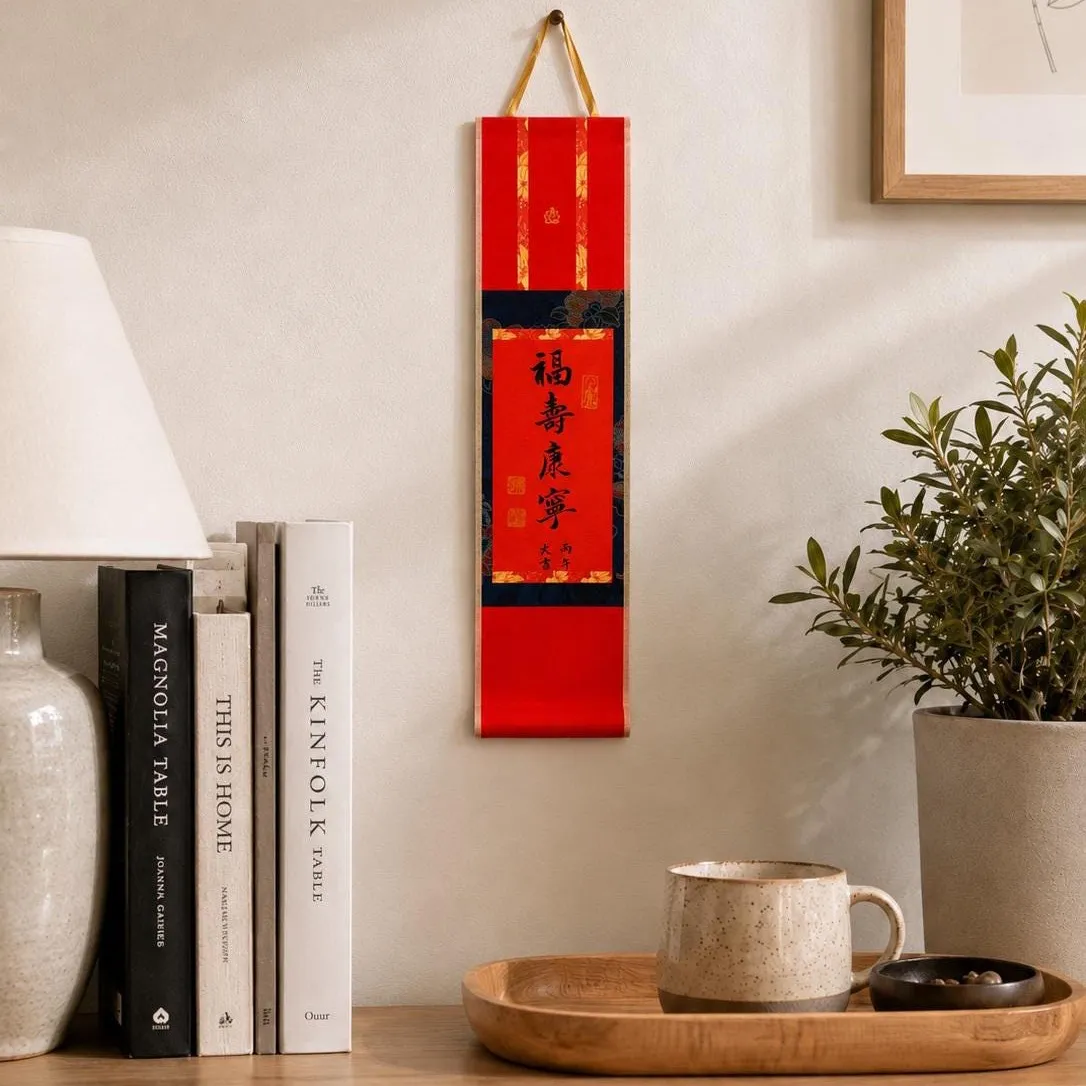
Photo shows a sample — yours will be brushed with the character you choose.
Wall Scroll — for walls & housewarmingsfrom $38→ -
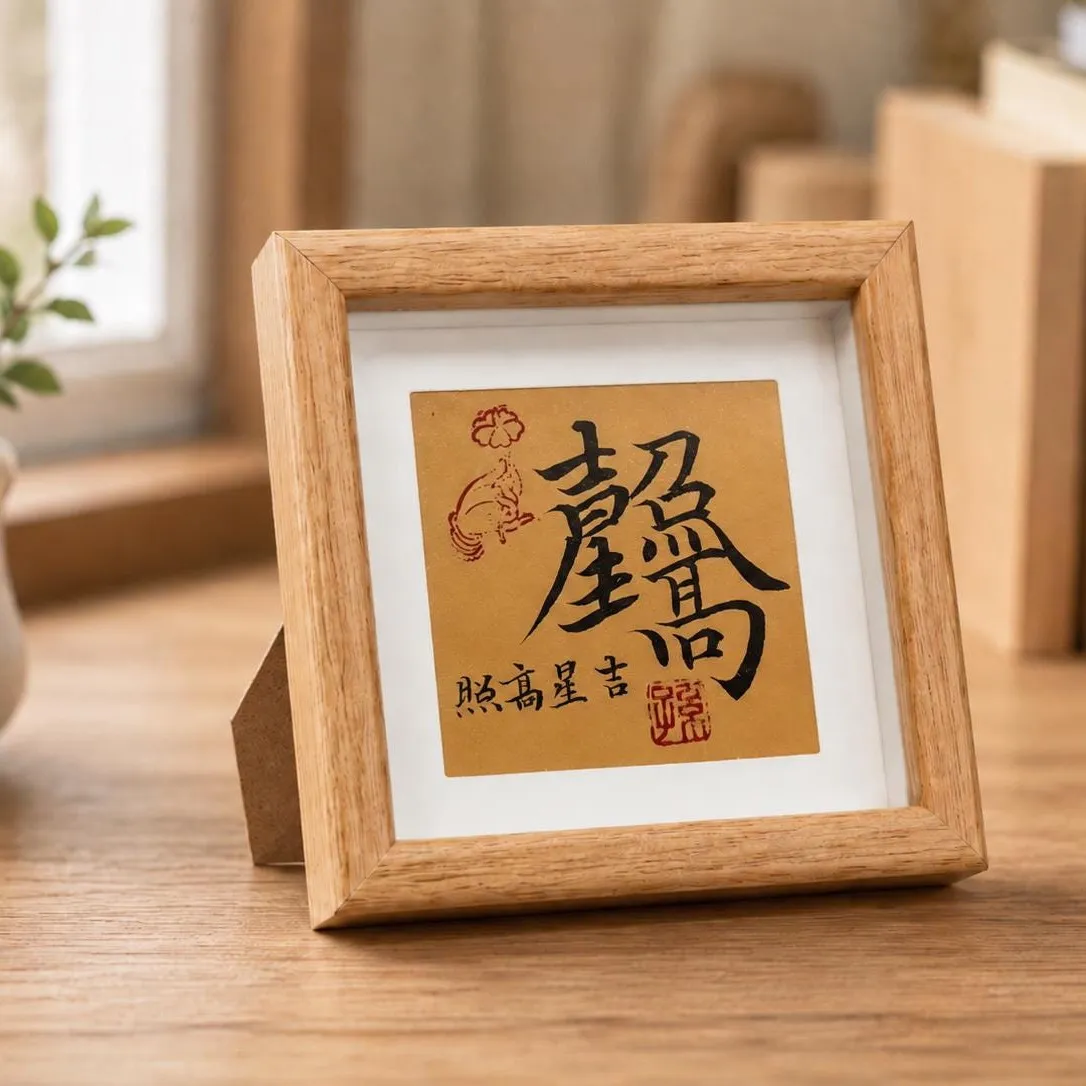
Photo shows a sample — yours will be brushed with the character you choose.
Desk Frame — for desks, studies & studiosfrom $44→ -
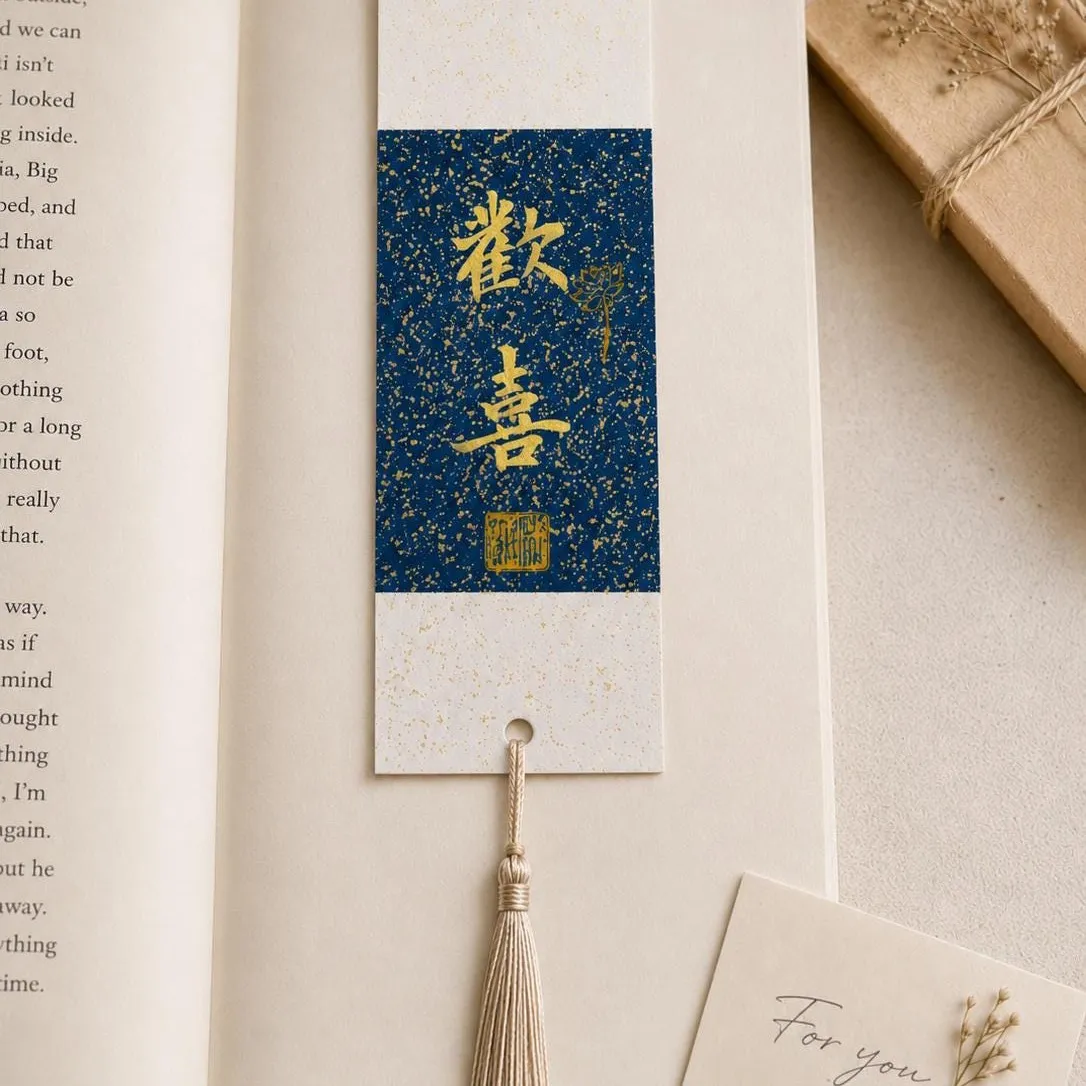
Photo shows a sample — yours will be brushed with the character you choose.
Bookmark — for readers & small thank-yousfrom $17→